Login
Signup
UKRAINE IN THE ANTI-APARTHEID STRUGGLE:
Solidarity And Complexity Of The Past For A Better Future
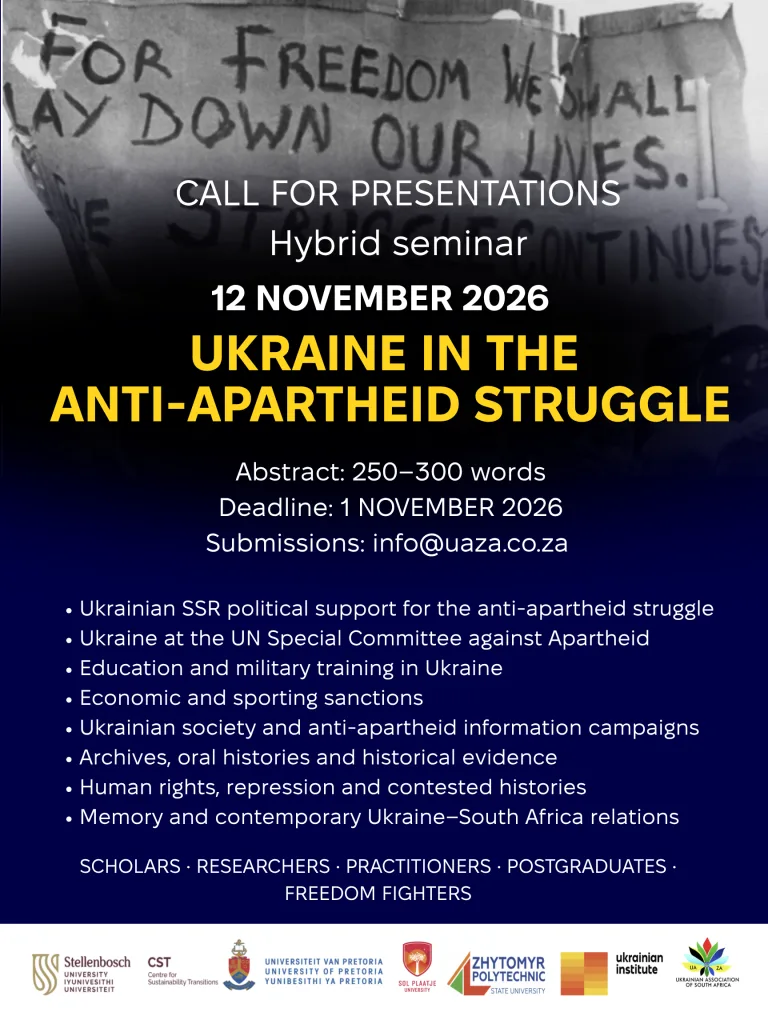
Hybrid Conference | 12 November 2026 | 13.00 – 17.30
Venue: Ukraine and South Africa
Language: English
Ukraine’s contribution, as a Ukrainian Socialist Soviet Republic and, since 1991, as an independent Ukraine, to the struggle against apartheid remains an important yet under-researched chapter in history. As the second largest of the 15 republics of the Soviet Union and a founding member of the UN, the Ukrainian Soviet Socialist Republic played an important role at the UN anti-apartheid committee since 1970 by initiating and promoting economic and sport sanctions, submitting reports about the violation of human rights in South Africa and working closely with the struggle leaders from the ANC, PAC, SACP and others. Many South African liberation fighters were trained and educated in Odesa, Perevalne, Kyiv, Kharkiv and other cities in Ukraine. Beyond that, Ukrainian society has also been involved in promoting the anti-apartheid struggle via media articles, regular collections of funds and research of the argumentation on legal violations by the apartheid government.
At the same time, the Ukrainian diaspora all over the world was using platforms, which the Soviet government created for assisting the struggle against apartheid, to raise questions about human rights violations committed in Ukraine by the Soviets themselves, such as systemic repression, political imprisonment, punitive psychiatric treatment, and assassinations of dissidents and other activists who dared to express independent political views.
This conference aims to bring together researchers from Ukraine, South Africa, and the global academic community to reflect on this complex historical period, the contribution of the Ukrainian SSR to the anti-apartheid struggle, and how this shared history shapes and affects contemporary South Africa–Ukraine relations, including the response following Russia’s full-scale invasion of Ukraine in 2022.
Selected presentations will be invited to submit full papers for publication, with an expected publication date at the end of 2027.
Organised by: Ukrainian Association of South Africa (UAZA), University of Pretoria, Centre for Sustainability Transition at the Stellenbosch University, Zhytomyr Polytechnic State University, and Sol Plaatje University.
With the support of Ukrainian Institute.
RECOVERING A SHARED HISTORY
The conference seeks to bring overlooked evidence, archival materials and personal histories into the historical record and to encourage new research on the connections between Ukraine and the liberation struggles of Southern Africa, as well as more complex analysis of the role of anti-apartheid support in promoting the human rights agenda in Ukraine.
We particularly welcome original archival research, oral histories, academic papers, case studies and interdisciplinary contributions, including research drawing on Ukrainian, South African and international sources.
CALL FOR ABSTRACTS
Abstract length: 250–300 words
Submit to: [email protected]
Submission deadline: 1 November 2026
Conference date: 12 November 2026
Conference time: 1 pm – 5.30 pm
THEMES
We invite submissions exploring, but not limited to, the following themes:
- Education and Military Training in Ukraine
- Ukraine’s Diplomatic and Political Support for the Anti-Apartheid Struggle
- Ukraine in the UN Special Committee Against Apartheid
- Ukrainian society’s information campaign against apartheid
- Repression of Human Rights in the Ukrainian SSR and the anti-apartheid struggle
- Ukrainian SSR’s role in promoting economic sanctions and sanctions in sport
- Archives and historical evidence – analysis of the available data and archives, their placements
- Memory and contemporary relevance — how the history of solidarity can contribute to contemporary Ukraine–South Africa relations and discussions on human rights, freedom and justice and shapes contemporary perceptions and responses to the war.
KEY AREAS OF UKRAINE’S CONTRIBUTIONS TO THE ANTI-APARTHEID MOVEMENT
Ukraine, the second largest of the 15 Soviet republics, became a founding member of the UN in 1945. Despite limited foreign policy freedom, it focused on supporting the anti-apartheid movement:
1. Education and Military Training in Ukraine
› ANC students in Kyiv: The first cohort of ANC students to pursue university degrees in the Soviet Union began their studies in Kyiv in 1962. Several of these students, including Sindiso Mfenyana, remained in Kyiv for a further five years to complete their studies.
› Military training: Members and cadres of uMkhonto we Sizwe (MK), the African National Congress (ANC), and the South African Communist Party (SACP) received military and political training in Soviet Ukraine.
› In November 1963, the first group of South African trainees arrived in Ukraine. It included Joe Modise (known as Thabo More) and Moses Mabhida.
› Between 1963 and 1965, 328 recruits received military training near Odesa. Among them were Oliver Tambo, Moses Kotane, Duma Nokwe, Joe Slovo, Ambrose Makiwane, Chris Hani, Ronnie Kasrils, Isaac Maphoto, Amos Lengisi, Simon Senna, Radilori John Moumakwe, Zola Skweyiya, and Zeph Makgetla.
› In the mid-1960s, the Soviet Union established a training centre for guerrilla fighters in Perevalne, in the Ukrainian SSR.
› 1986, as the prospects for the political transition of SA were evident, ANC members began a 3-year course for motorised infantry officers in Perevalne. Since 1987, 5-year officers’ courses for helicopter and jet pilots, flight engineers or naval officers. In 1969, 500 cadres were trained during their temporary evacuation from Tanzania to Perevalne.
› 1968, MK negotiated nursing training for their cadres in Kyiv Medical School.
2. Ukraine’s Diplomatic and Political Support for the Anti-Apartheid Struggle
› The Ukrainian SSR strongly supported measures against the apartheid government. In 1962, with the Ukrainian SSR among the states advocating a strong international response, the UN General Assembly adopted a resolution recommending stringent diplomatic, economic and military sanctions against South Africa.
› In 1963, Oliver Reginald Tambo, then Deputy President of the ANC, wrote a letter of thanks to the Foreign Ministry of the Ukrainian SSR. On behalf of millions of South Africans, he expressed gratitude to Ukraine for its support for the 1962 UN General Assembly resolution calling for sanctions against the South African government. Tambo praised this support for justice and human rights and expressed his belief that Ukrainian efforts would help end apartheid.
› In 1985, the Ukrainian SSR Mission to the United Nations endorsed comprehensive sanctions against South Africa, reinforcing its longstanding position in support of international measures against apartheid.
3. Ukraine in the UN Special Committee Against Apartheid
› Since 1970, the representative of the Ukrainian SSR served on the UN Special Committee Against Apartheid, contributing to the international campaign against the apartheid system. It included diplomatic advocacy, support for sanctions, participation in UN decision-making, and involvement in efforts to isolate apartheid South Africa economically and in sport.
› The Ukrainian SSR representative served as a Vice-Chairman of the UN Special Committee Against Apartheid and participated in the development and co-sponsorship of numerous resolutions condemning apartheid.
› In August 1976, the first special report, ‘The Soweto massacre and its aftermath’ was transmitted by the Acting Chair, Volodymyr Martinenko
› The Ukrainian SSR was particularly active in developing and promoting economic sanctions and measures targeting South Africa’s participation in international sport, supporting the broader international isolation of the apartheid regime.
4. Ukrainian society information campaign against apartheid
› Public press to inform the population about apartheid and UN anti-apartheid activities.
› Public lectures, educational programmes and dissemination of international legal instruments against apartheid.
› Annual solidarity days and weeks (e.g. the International Day for the Elimination of Racial Discrimination, Week of Solidarity with the Peoples of Southern Africa);
› Public meetings and gatherings of workers, academics, artists and students.
› Efforts to mobilise public opinion against apartheid, racism and colonialism.
› International Law research on the legal prohibition of apartheid and racial discrimination.
5. Repression of human rights in the Ukrainian SSR and the anti-apartheid struggle
› While being on the front line of the Anti-Apartheid committee, the Ukrainian SSR was leaving UN Human Rights Committee’s questions about human rights in Ukraine with no answers, suppressed expressions of Ukrainian national identity and political dissent, opposed Ukrainian aspirations for greater political autonomy or independence, imprisoned Ukrainian dissidents, writers, religious leaders and human rights activists and restricted freedom of expression, association, religion and movement.